A new website built on our own CMS: accessibility, security and performance
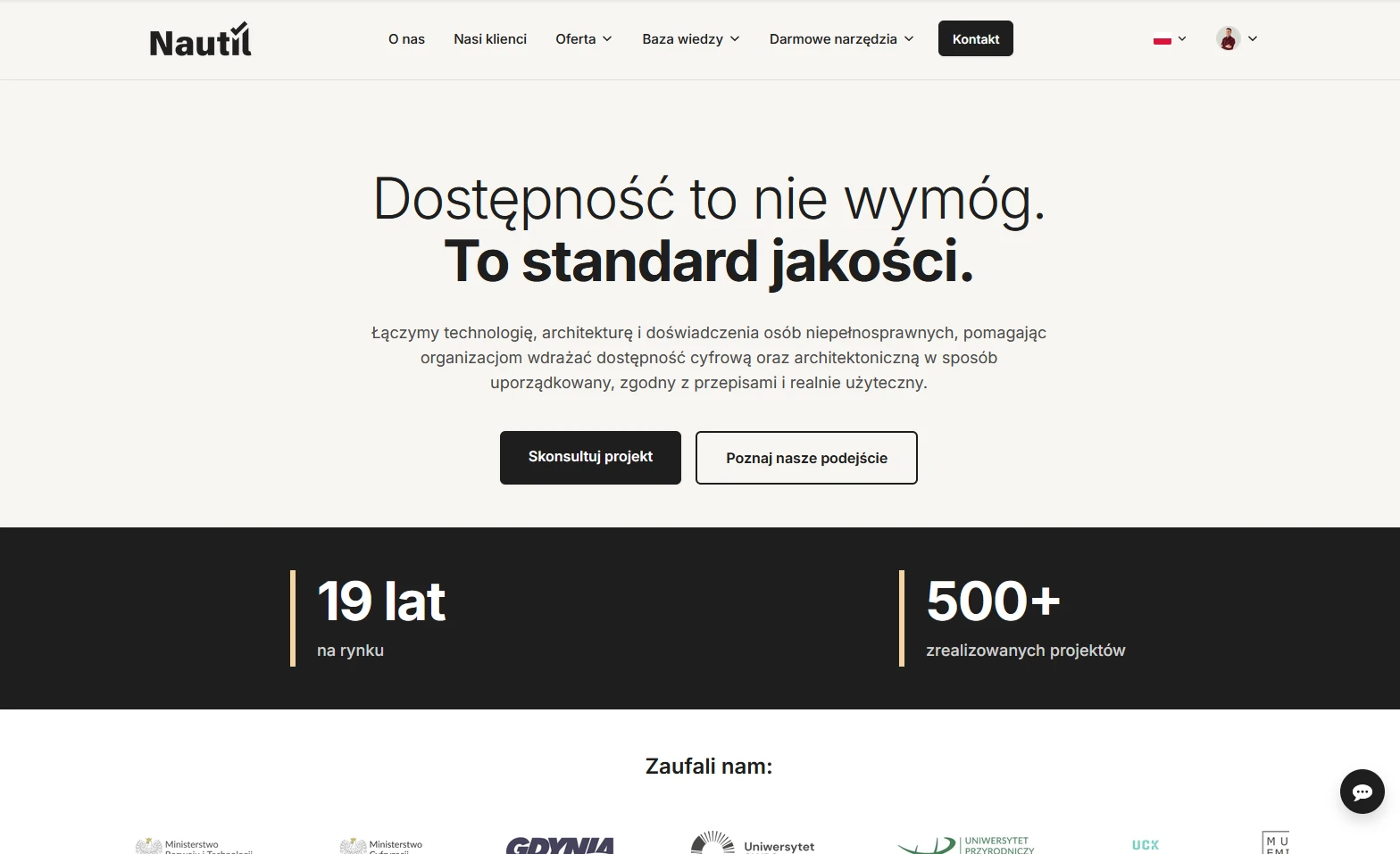
After ten years of audits, training and work with users, we have built a new website on a content management system of our own. Here is why we did not reach for an off-the-shelf CMS, and how accessibility, security and performance shaped every decision.
Ten years of experience in digital accessibility
We have worked in digital accessibility for ten years, building our knowledge through training sessions, digital accessibility audits and day-to-day work with our clients. They include both public institutions and private companies for which accessibility is an important part of how they communicate and deliver services.
Over that time we have carried out a great many accessibility audits and have come to know the problems website users run into most often. The work we have done together with people with disabilities has been particularly valuable: it has helped us understand their needs and expectations far better.
At some point we decided it was time to put all of that knowledge into a new website of our own. One that would be not only our calling card, but also a working example of how we approach accessible, usable and secure digital design.
Artificial intelligence supports specialists, it does not replace them
We live in a time when tools based on artificial intelligence can genuinely speed up the process of designing and building websites. AI assistants help with writing code, reviewing technical options, automating repetitive work and spotting potential mistakes.
Even so, the most advanced artificial intelligence will not replace the knowledge, experience and deliberate decisions of specialists.
Building a website that is accessible, usable, fast and secure at the same time takes far more than generating correct code. It calls for a working knowledge of accessibility principles, an understanding of how different groups of people use technology, and the ability to design interfaces that make sense to them.
Those are exactly the things we concentrated on while working on our new website. We treated artificial intelligence as a tool that supports the work of specialists, not as a replacement for their expertise.
Why we chose to build our own CMS
One of the most important decisions in the design of the new site was the choice of a content management system (CMS).
We could have used a popular platform such as WordPress or Joomla. These are mature systems with a great deal to offer, but their popularity also makes them a frequent target of cyberattacks.
Risks can come from outdated software, vulnerable plugins, incorrect configuration or weak protection of administrative access. In the worst cases, security holes can lead to malicious code being injected, to a site being taken over, or to unauthorised access to data.
This does not mean that popular content management systems are unsafe by design. They do, however, require proper maintenance, regular updates and conscious management of every additional component.
So we took a different route. Drawing on our experience in building websites, in digital accessibility and in cybersecurity, we developed our own CMS. It gives us far more control over the architecture of the site, the way content is managed and the safeguards we put in place.
A custom CMS built on PHP 8.5
Our content management system is built on PHP 8.5. In designing it we wanted to combine the flexibility familiar from popular platforms with high performance and the freedom to tailor the system fully to our needs.
One of our guiding principles was to reduce dependence on external plugins and add-ons. In large content management systems, every additional plugin can mean more code, more dependencies and one more thing to watch for updates and vulnerabilities.
In our system we can design and build the features we need directly. That keeps unnecessary weight out of the site and gives us a clearer view of how it behaves.
Above all, a custom CMS gives us:
- Flexibility – features can grow in step with what we actually need.
- Performance – fewer unnecessary components and a site tuned for speed.
- Control over security – protective measures designed on purpose, and full ownership of the system's code.
- Independence from external plugins – fewer moving parts to update and maintain.
- Room to improve accessibility – both the site and the editing tools can be adapted to meet WCAG 2.2.
Our aim was never simply to build one more CMS. We wanted a system we would have full control over and could keep developing on our own terms.
Digital accessibility as the foundation of the new site
We knew from the start that accessibility could not be an extra bolted on at the end of the project. It is one of the foundations of the whole thing.
As we design the site, we draw on what we have learned from audits and from working directly with people with various disabilities who are part of our team.
We pay particular attention to a logical content structure, correct use of headings, keyboard operation, a legible interface and support for assistive technologies such as screen readers. We also keep in mind people who may face cognitive difficulties, low vision or limited mobility.
An accessible website should be comfortable and understandable for every user, whatever their abilities, whatever device they use and however they choose to move around the site.
That is why we care not only about meeting the technical requirements of digital accessibility, but about our site being genuinely useful.
Our website keeps evolving
Launching a new website does not mean the work on it is finished. Quite the opposite – we treat it as a project to be developed and refined over time.
We are adding new features, reviewing what is already there and working to make information about our services as easy to reach as possible. We want everyone who visits the site, whether or not they use assistive technology, to be able to read about what we do and find what they need without obstacles.
We also know that digital accessibility is a continuous process. Even years of experience and careful testing are no guarantee that a barrier will never appear. That is why we remain open to comments and suggestions from the people who use our site.
Run into a barrier? Write to us
If you come across any difficulty while using our website, we want to hear about it. Perhaps something is hard to read, does not work properly with a screen reader, cannot be operated from the keyboard, or is presented in a way that makes the content hard to follow.
Please do not wait – write to us and tell us what did not work. Ways to report barriers are also collected in our accessibility statement.
Every report of this kind is a valuable pointer for us and a chance to improve the site further. We believe the best solutions come from combining technical knowledge, the experience of specialists and the real needs of the people using a site.
We build our website with everyone in mind. Help us make it more accessible still.