How to audit swimming pools with accessibility in mind? The “Dostępna Pływalnia” programme is more than a chance for funding
Accessibility is more than a ramp and a lift. It is a way of thinking about space in which everyone – regardless of age, ability or needs – feels welcome and safe. That is precisely why the “Dostępna...
Accessibility is more than a ramp and a lift. It is a way of thinking about space in which everyone – regardless of age, ability or needs – feels welcome and safe.
That is precisely why the “Dostępna Pływalnia” (Accessible Swimming Pool) programme is attracting so much interest. Thanks to the extended application deadline – until 15 July 2025 – many local authorities and operators have gained extra time to analyse their facilities and submit a well-considered funding application.
But how do you prepare properly for this process? Where should an accessibility audit of a swimming pool begin?
 What should you check during the audit?
1. The surroundings of the pool
– Can a wheelchair user get from the bus stop or car park to the entrance without barriers? Are parking spaces designated and properly marked?
2. Entrances and internal circulation
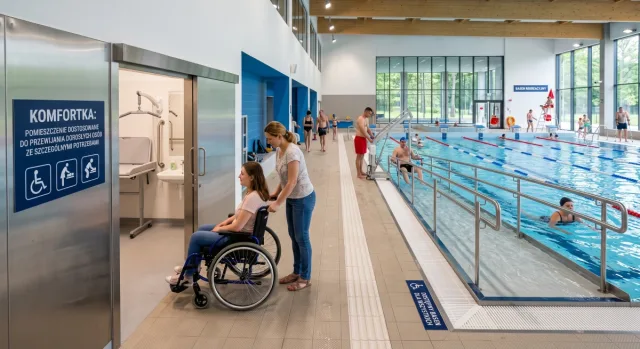
– Automatic doors, contrasting markings, no thresholds – these are the details that make a difference. Inside – wide corridors, clear signage and access to all areas, including technical and lifeguard areas.
3. Changing rooms, toilets and showers
– Does each of these spaces have a manoeuvring area of at least 150×150 cm? Are grab rails and fittings at the right height? Can the showers be operated without assistance?
4. The pool area
– Access to the pool basin: ramps, hoists, handrails, non-slip surfaces. Safe, contrasting depth markings are also important.
5. Communication and information
– Legible signs, pictograms, Braille markings, easy-to-understand language, materials available digitally and in print. Do staff know the basics of communicating with deaf or blind people?
 Accessibility is a whole
An accessibility audit is not just a list of errors and shortcomings. It is an opportunity to understand how a facility can become genuinely welcoming – for an older person with a walking stick, a child with a carer, an autistic person or a blind swimmer.
Good audits also show that most of the necessary changes do not require huge outlays. Small adjustments are often enough: adding contrast, moving a grab rail, a description in easy language, reorganising the space.
 You have until 15 July 2025
It is worth making good use of that time. A well-planned audit is not only a step towards a grant, but also an investment in the quality of the facility, the comfort of its users and peace of mind for staff.
Accessibility is not an obligation. It is a standard that pays off.